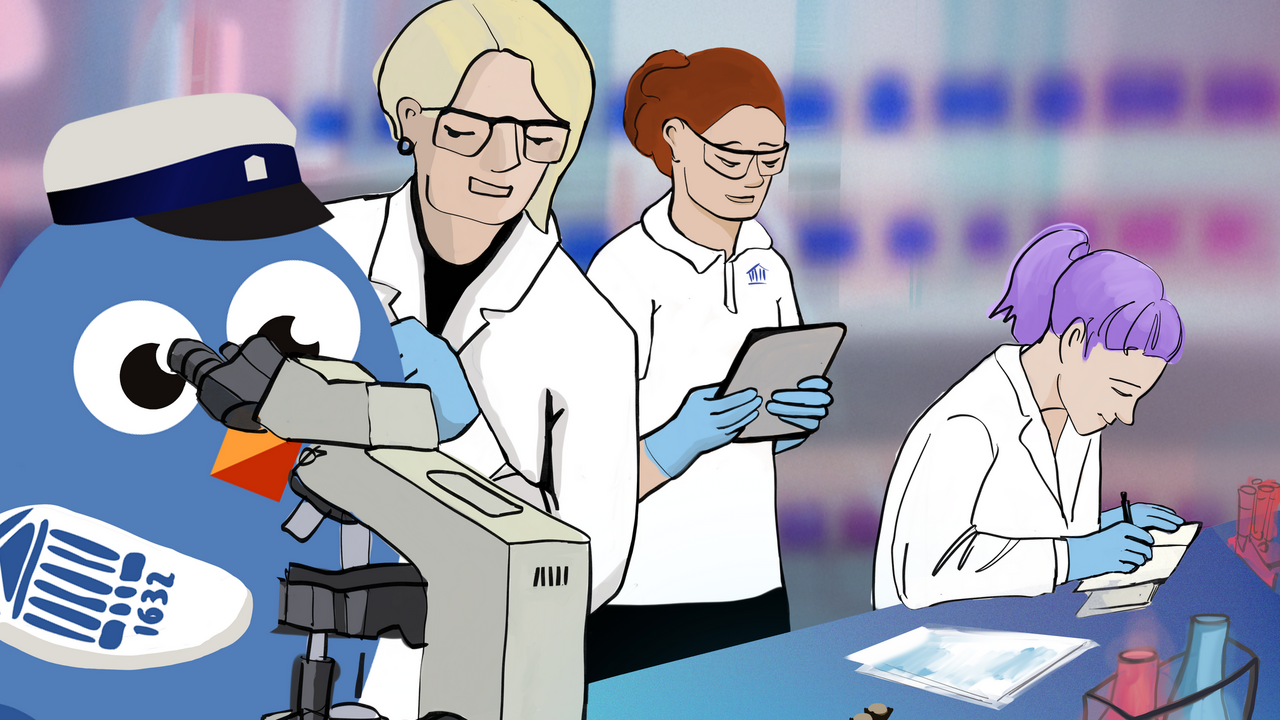
From 9 to 15 February, the Women in Science theme week was held at the University of Tartu to highlight the role of women and girls in science, break gender stereotypes and encourage women to pursue careers in science. The panel discussion on 11 February focused on gender equality and related AI issues. Watch the discussion on UTTV.
The theme week focused on the impact of artificial intelligence on equality. Although AI can be highly beneficial, it can present biased data that reinforce inequality. This may particularly concern fields in which women and minorities are underrepresented, such as STEM and ICT. “Career has no gender, but as long as statistics do not confirm it, we must act consciously to reduce inequality,” said Ester Oras, Professor of Archaeochemistry at the University of Tartu and one of the initiators of celebrating the Day of Women in Science in Estonia
On 11 February, a panel discussion, moderated by Raili Marling, Professor of English, was held in the lobby of the Institute of Foreign Languages and Cultures (Lossi 3). Experiences and insights were shared by Eneken Riin Salong, President of the Student Body and a student of the Faculty of Social Sciences, Andra Siibak, Professor in Media Studies, Helen Eenmaa, Associate Professor of Governance and Legal Policy, Liina Kamm, Senior Researcher at the IT company Cybernetica AS, and Sten Torpan, Lecturer in Crisis Sociology.
- Artificial intelligence is not neutral: it learns from existing data and may therefore reinforce pre‑existing stereotypes and inequalities. If it is not carefully monitored and corrected, it can perpetuate the idea that certain roles or fields are more suitable for one gender than another.
- Responsibility must remain with humans: artificial intelligence can be a useful tool, but final decisions – especially those that affect people’s lives and careers – must be made by humans. It must also be clear who is accountable when the system makes a mistake.
- Equality requires informed action: if people with similar backgrounds make decisions and carry out technological development, the limited perspective will be reflected in the results. This is why different people and perspectives must be represented in science and technology.


On 12 February, French cultural historian Sophie Turner led a curator’s tour of the University of Tartu Art Museum’s exhibition Voltaire: Making History, focusing on Émilie du Châtelet, the woman who played an influential role in Voltaire’s life and, more broadly, in the scientific and cultural history of the era. Although Émilie du Châtelet worked alongside Voltaire, she has largely faded into obscurity.
Social media campaign
During the theme week, the University of Tartu and the Estonian Young Academy of Sciences invited all researchers, both women and men, to participate in a social media campaign aimed at highlighting the scientific achievements of women. The campaign encouraged researchers to speak about women who have inspired them or helped shape their academic paths. Authors were recommended to use hashtags #NaisedTeaduses and #WomenInScience when sharing the posts.


The International Day of Women and Girls in Science has been celebrated since 2015. In Estonia, the day has been celebrated since 2021 at the initiative of the University of Tartu and the Estonian Young Academy of Sciences. Every year, the Baltic national academies of sciences and the National Commissions for UNESCO also organise the scholarship competition For Women in Science.