

Students' feedback
This page features the ENLIGHT network students' feedback on various conferences, seminars, BIPs and international studies.
Andrus Piigli, a student in the Bachelor’s programme in Vocational Teacher Education, participated in the Erasmus+ Blended Intensive Programme (BIP) “Inclusive Education” in January 2026, organised by Comenius University Bratislava. The programme combined online learning with a physical mobility period in Bratislava.
What made you decide to take part in a blended mobility programme, and why this particular university?
“I wanted to learn how inclusive education is understood in other countries and which approaches are used there. Slovakia also caught my attention because of its historical background: Estonia and Slovakia have followed different development paths, but both countries used to be part of the Soviet sphere of influence. It was interesting to compare how educational development has progressed and how learner diversity is taken into account today.”
How much of your expenses were covered by the grant?
“The Erasmus+ grant covered most of my expenses, including travel, accommodation and living costs during the mobility period. The cost of living in Bratislava was also quite reasonable. For example, a decent meal cost around €12 and a beer about €3. I mainly spent my own money on leisurely activities, but even those additional costs were fairly modest. Financially, the mobility period was not a burden for me.”
What did a typical day during the blended mobility programme look like?
“Classes usually took place from 9:00 a.m. to 3:00 p.m., with lunch and coffee breaks spread throughout the day. There was a lot of group work, discussion and analysis of practical examples. The activities were varied, which kept the learning process engaging and dynamic. It was not simply a matter of listening to lectures. Rather, participants were constantly encouraged to contribute and compare their experiences with those of students from other countries.”
How did the BIP influence your studies at the University of Tartu?
“The most noticeable change was that I became much more confident communicating and expressing my ideas in English. The international nature of the course contributed greatly to this - there were participants from Estonia, Sweden, Ireland, Spain and Slovakia. Through group work and discussions, we were able to compare different countries’ experiences and perspectives on inclusive education.”
“The course broadened my understanding of inclusive education considerably. In our discussions, we addressed issues related to learners’ religious and racial backgrounds, family differences, special educational needs and communication challenges. During a school visit, I saw why taking these differences into account is so important in practice. Students from very diverse backgrounds studied together, and lessons were designed in a way that enabled everyone to participate. I realised that support may also be needed by a student who does not struggle academically but might be afraid of speaking in front of the class. Inclusion means that teachers are prepared to recognise both the opportunities and the barriers faced by every learner.”
“The BIP provided an international point of comparison alongside my studies at the University of Tartu. Learning about the experiences of other countries helped me better appreciate both the strengths of the Estonian education system and the areas that deserve more attention. I quickly realised that many things are actually done very well in Estonia.”
What advice would you give to someone considering applying for a BIP?
“I would definitely recommend taking advantage of this opportunity. Mobility broadens your horizons, gives you new ideas and allows you to compare your home university with other universities and education systems. There is no need to be overly concerned about your English skills, as confidence grows through using the language.”
“There is also no need to worry that being older than the other participants will make you feel left out. Most participants on the course were around 20 to 25 years old, while I took part in the programme at the age of 40. Even so, I quickly found my group. After the very first day, we went looking for a place to play billiards together. The local participants also showed us around the city, allowing us to experience Bratislava from a different perspective than on a typical tourist trip. These personal guided tours and the relationships that developed were a very valuable part of the overall experience alongside the academic programme.”

I went on an exchange semester in the autumn semester of the 2025/26 academic year, which was my first experience studying abroad. In some ways, choosing the Basque Country was quite an easy decision. I knew I wanted to go somewhere far from home and somewhere I had never been before. I also wanted to live in a place larger than Estonia and larger than Tallinn or Tartu. I wanted to see whether or not I could adapt to such an environment. Italy, France, and even South Africa interested me, but I ultimately decided against them because I could not find suitable courses or because the destination did not appeal to me strongly enough.
Friends of mine who had visited Bilbao spoke very highly of the region, and after learning about its unique history and language, I decided on the Basque Country. At the same time, I must be honest: I am a huge football fan, and that also influenced my decision. Bilbao’s team, Athletic Bilbao, has a very distinctive culture, according to which all players must either be born in the Basque Country or have grown up there. During my exchange semester, I had the opportunity to watch one of their UEFA Champions League matches, which had been a long-time dream of mine.
Before leaving, I felt a mixture of anticipation and excitement. The Basque Country seemed like an undiscovered corner of Europe to me. During the preparations, I paid particular attention to the required documents, which turned out not to be overly complicated, and then focused on finding accommodation. I came across various warnings about scammers and tried to avoid every possible trick they might use. In fact, because I was perhaps too cautious, I even missed out on one accommodation opportunity.
Settling in was surprisingly easy. Before my departure, I connected with a few Estonian students, and we remained friends throughout the exchange semester. My social circle then expanded through lectures, events, and various activities. I was also fortunate with my flatmates. One of them was an English teacher from the United States who loves Estonia. He had Estonian sweets, regularly practised Estonian, spent New Year’s Eve in 2024 at a spa located just a hundred metres from my home, and had even worked at a summer camp near my family’s countryside home. We even managed to meet again during the summer.
My first impressions were excellent. I arrived directly in the city centre and spent the bus ride from the airport admiring the mountains and the surrounding landscape. The city centre itself was beautiful as well. On my first evening, I went out to explore and felt like a complete tourist, amazed by everything I saw. Everything was new and exciting. For the first time in my life, I was experiencing it all completely on my own.
My exchange semester gave me a valuable perspective on my future, particularly regarding further studies and where I might like to live. I have always considered my English skills to be quite strong, but I before the exchange semster, I had never studied subject-specific courses or foreign languages in English. The experience also broadened both my horizons and my network. I now have valuable connections in around 80% of European countries and on every continent. In addition, I learned Spanish and learned to appreciate things in the present rather than dwelling on the past. Most importantly, I learned not to be afraid of new experiences.
Robin Markus Masing, student of Information Society and Social Well-being

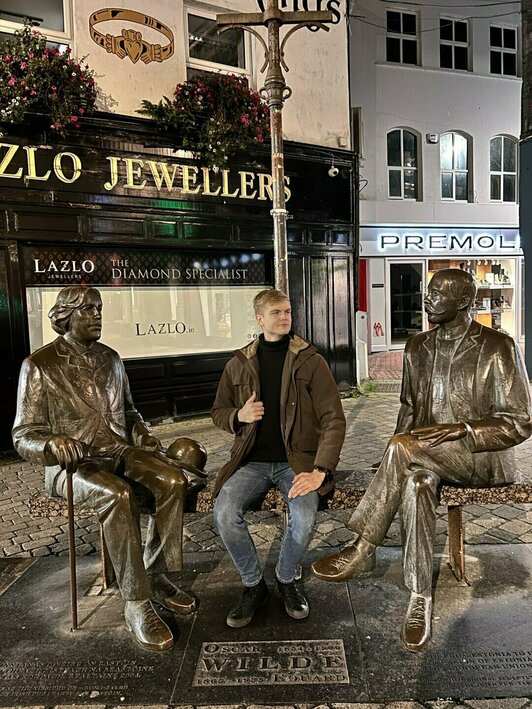
Rando Simson, a student of Modern History at the Institute of History and Archaeology, spent five days studying a BIP course at the University of Galway in Ireland during the autumn of 2024. His time there provided an opportunity to meet students and professors from various nationalities.
"In seminars and discussions, we learned about each other's countries' historical issues and perspectives. Additionally, the course included a trip to Dublin and events organised by local students that introduced Irish culture. It was a useful and memorable experience, which, due to its short duration, did not interfere with my regular studies," said Simson.
Rando Simson, student of Modern History at the Institute of History and Archaeology.
Mariete Tamm, a political science student at the Johan Skytte Institute of Political Studies at the University of Tartu, studied as an exchange student at the University of Bern in Switzerland in the autumn of 2024. The experience gave her the opportunity to study at a university with a strong academic background and to be part of an international learning environment with English as the working language. "In addition, it is possible to establish connections with other partner universities. For example, you can take courses at the University of Fribourg, which is just a half-hour train ride from Bern," said Tamm.

In addition to the strong educational system and international environment, Mariete Tamm highlighted the active international student network at the University of Bern, which organises exciting events every week, offering opportunities to meet new people. The studies are also slightly more affordable thanks to additional scholarships from the Swiss-European Mobility Programme, SEMP.
"The advantage of Bern is its location in the heart of Switzerland, allowing travel by train both within the country and to neighbouring countries. At the same time, the city is calm, student-friendly, and safe," said Mariete Tamm. Her second choice would have been Ghent University, about which she had also heard positive feedback.
Tamm emphasised that one of the biggest perks of studying abroad was the possibility to create international relationships. She met with people of various cultural and traditional backgrounds, which led to her being more open in regard to differences. Tamm also expressed that for her, the variety of educational systems was eye-opening, offering a more independent and practical approach to studying.
She heard about ENLIGHT via the student newsletter and will consider studying abroad once more and taking part of ENLIGHT conferences in the future.
"I'm grateful for the experience and recommend studying at the University of Bern," she concluded.
Quotes
"Studying at the University of Groningen through the Erasmus BIP Course has been an exceptional experience that has not only expanded my academic knowledge but also enriched my personal growth. I would highly recommend this university to any student seeking a challenging yet rewarding educational experience in a welcoming international environment."

"One of the biggest values was to create international relationships. Additionally, I got to study at a university with a strong academic background and to be part of an international learning environment with English as the working language."

"Spending an entire semester abroad might seem intimidating at first, but once you’re there, there are so many events and interesting people that you don’t even have time to feel like you don’t belong."

"It was a useful and memorable experience, which, due to its short duration, did not interfere with my regular studies."

